

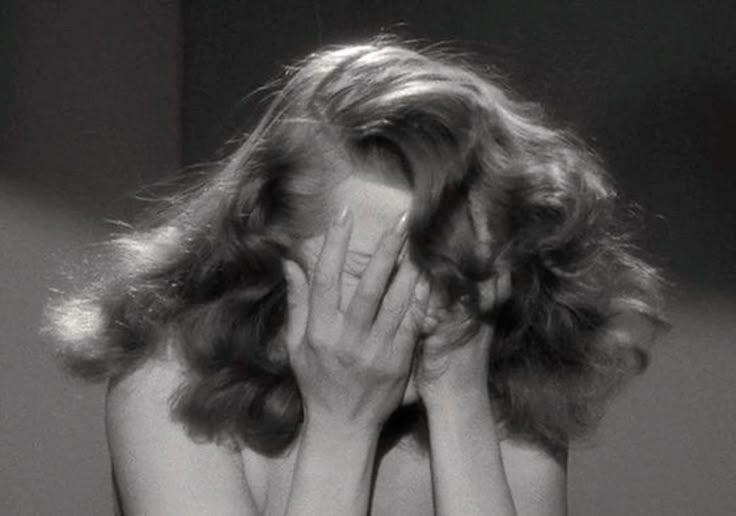
Between the ages of about twelve and fourteen, I became very keen on what I can best describe as “Mob Movie Music”—lots of Frank Sinatra, Dean Martin, Santo and Johnny, Bobby Vinton, anything Doo Wop, and the like. Somehow, my developing mind had created an association between popular mid-20th-century music and the notion of Glamor. I was likely primed to think this at that point through a slew of cultural references I didn’t fully understand and yet had already internalized.
I believe this to be the first time I truly sought out a particular genre or style of music on my own accord and not under the influence of the radio or my music teachers or the algorithm. It was through those songs that I found myself listening to music in a completely different way, not as a narration of my emotions or out of pure enjoyment, but for the sense of going somewhere else. I’d close my eyes, the world would fade to black, and I was offered a sort of dreamscape. It was a deeply escapist fixation and an unsurprising one in retrospect, as those years were defined by an oppressive environment and a burgeoning sense of alienation.
It is funny to me now to listen back to those songs, most of which I now find extremely corny. This was also around the time I became invested in watching popular old movies beyond some passive awareness. When I was twelve, I remember watching strictly Marilyn Monroe movies during an international flight. And I even named my cat “Cat” when I was in the eighth grade (yes, like in Breakfast at Tiffany’s). There is nothing cool about this music or those movies, they were simply part of the popular culture of their time. But I have to remember I was a child and I respect the earnestness with which I was engaging with the world. I hoped for something beyond myself and my conditions and looked towards Glamor.
Glamor is said to be derived from the word “grammar” and earlier uses of the word reference occult scholarship. This etymology doesn’t stray too far from contemporary notions of Glamor, which is a kind of studied enchantment. The extremely contrived nature of Glamor drives a lot of people away from it and its frequent use in advertising does not help its reputation. For decades now, our ideals have shifted towards authenticity, which I find sort of ironic as aspiring toward authenticity is inauthentic in its own right. You can only shout “I HAVE NO EGO” so many times before I begin to doubt that fact.
In Virginia Postrel’s book The Power of Glamour, she defines Glamor as “an emotionally compelling alternative, focusing inarticulate longings on totems that imply change…[the] promise of escape and transformation”. Key to this definition is the relationship between escape and transformation: it is through our belief that there is an escape that we can transcend. There is no Glamor without an awareness that there is dark just as much as there is light and it is in that darkness that we choose to seek out light.
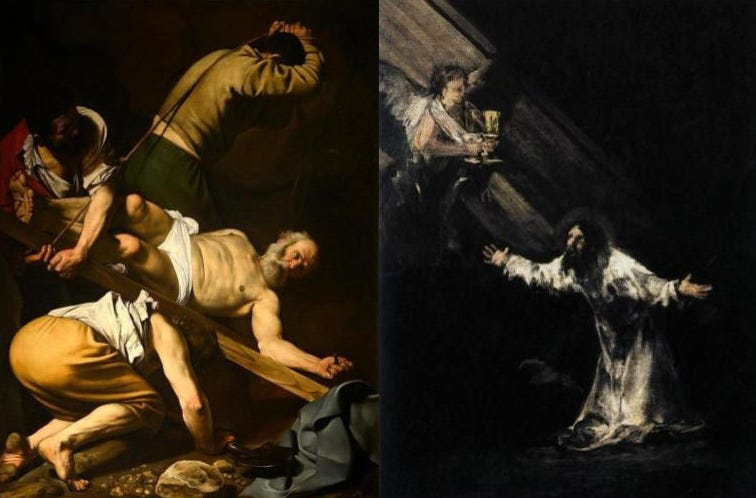
We can maybe consider the origins of Glamor in the West as part of the Genesis story when God separated light from dark. Painters like Caravaggio and Goya were keen on using the element of chiaroscuro, the style of heightened contrast in shading, to depict religious motifs. Of course, the Abrahamic religions are not the only ones to consider this contrast, but I am merely commenting on the manifestation of those themes in certain contexts.
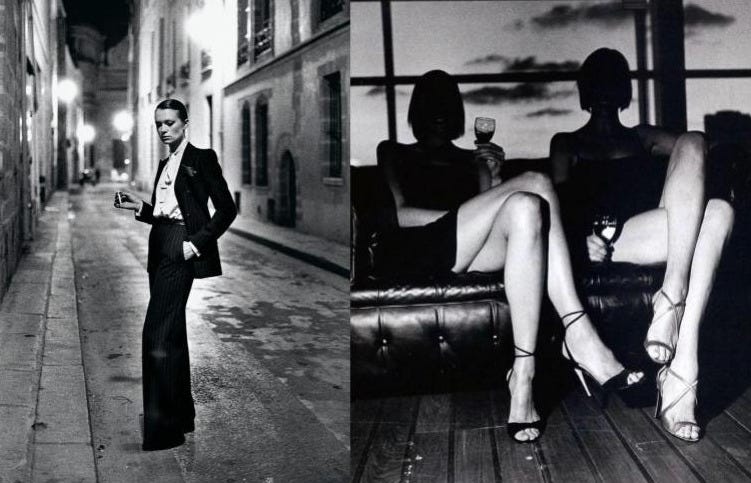
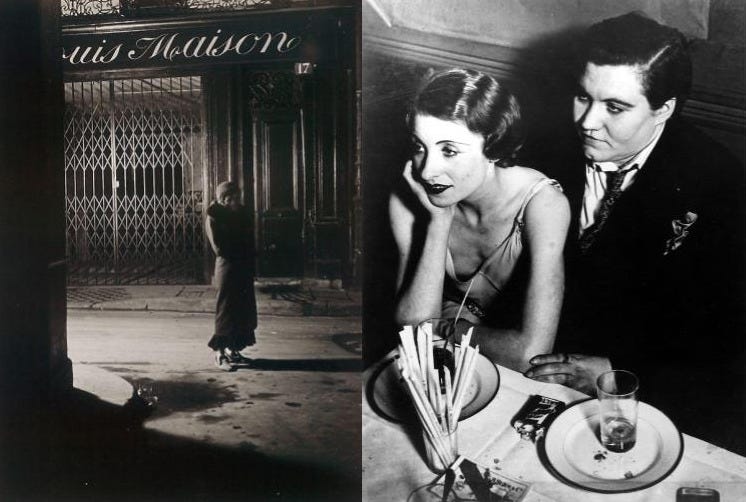
This continues to play out in more modern visual representations of Glamor, for example in black-and-white photography. Helmut Newton’s fashion photography is probably the most recognizable in this regard but I am a big fan of Brassaï, as he aptly captured the gritty essence of early 20th-century Parisian street life and the liveliness of his subjects.
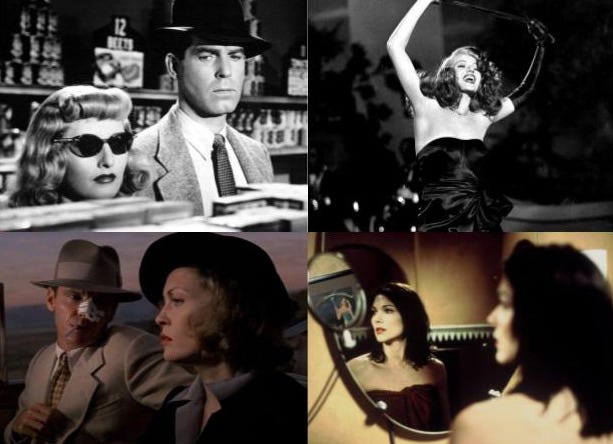
Noir films are where Glamor is most fully articulated (and their visual codes seeped into the subconscious of my pre-pubescent mind before I could even name it). Noir films are incredibly sensitive to politics, as an extension of the influential legacy of German Expressionism and the changing social mores of the 1940s. Playing with high-contrast visual cues allows ideas—about power, gender roles, racism, greed—to be communicated implicitly rather than just spelling it all out.

Los Angeles is, of course, the most Glamorous city for this reason. This is why so many noir and neo-noir films are set in Los Angeles—not just because it is the center of multiple Glamor industries, but because it is the embodiment of all the successes and failures of the American way of life. Even past the mountains and the plains and the desert, through all the promises of Manifest Destiny, the darkness cannot be escaped. All attempts to eschew this fact are only met with an equal and opposite reaction. New York City is also glamorous but it communicates it explicitly, through continental appeal and inescapable grittiness and its compact urban landscape and enormous skyline. The Glamor of Los Angeles is spiritual and pulsates atmospherically. Perhaps this is why riots and protests that occur in Los Angeles are always so shocking and so intense, because the chaos that erupts comes as a reaction to so many forces trying to push it away.
Last fall, I came across the social media profile of Dara Allen and became a quick fan. Allen is a stylist and fashion director of Interview with an incredibly recognizable personal style that takes influence from Pop Art and 1960s Mod. She describes her style as “cinematic and character driven”. Playful and chic, she reminds me of why I ever loved Glamor in the first place. There is so much intention behind it, so much thought and care. Glamor is fully embodied. It is incredibly refreshing, especially in today’s world where efficiency and convenience are prized above all, and self-effacing attitudes that fear appearing as if they are “trying” are in vogue.

I feel as though Glamor is deeply misunderstood. I think through years of its manipulation it has come to mean something stupid at best and perverted at worst. Stupid in the sense that it can simply be the green light for empty consumerism, like high fashion coffee table books and buying things just for the label. But the real perversion comes from those with nostalgic impulses that lean on Glamor in an attempt to return to something that never was. Their conservative attitudes fundamentally misunderstand the nature of Glamor. Glamor is not without fear or darkness—it exists because of those feelings not through the denial of them. This is where true transcendence comes from. It is also why any interpretation of Glamor that fails to acknowledge this comes off as incredibly tacky, and not in a playful way.
This is why I at times have to check my own nostalgic tendencies, to remember why it all mattered to begin with. I sometimes think about this one tweet whenever I start feeling low and begin harping about people’s poor taste:
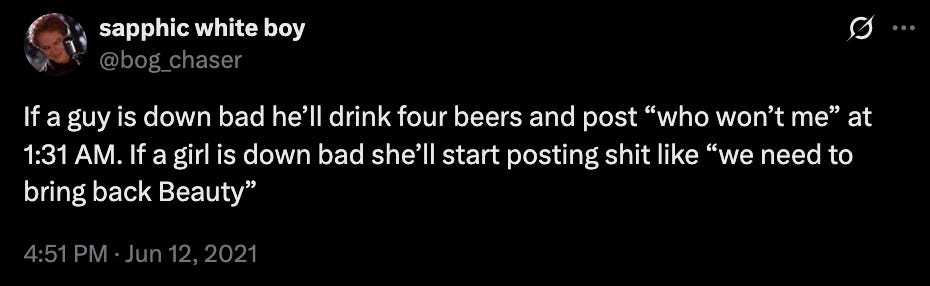
Reality is often disenchanting, especially for those who cannot seem to find themselves at the center of it. I look to Glamor not only as a refuge but as a beacon. That reality can be reconstructed to find something of real meaning. So perhaps we really do need to Bring Back Beauty but in the sense that we should be animating our reality in the hopes that we find something beyond ourselves.
This was such an entertaining read! The reference to the etymology of Glamor reminded me of the word “awe” was thought to have derived from an archaic English word for “dread.” I’ve always been super fascinated by this study so it’s fun to find others who also share that interest!