Let's Play!
hut hut hike

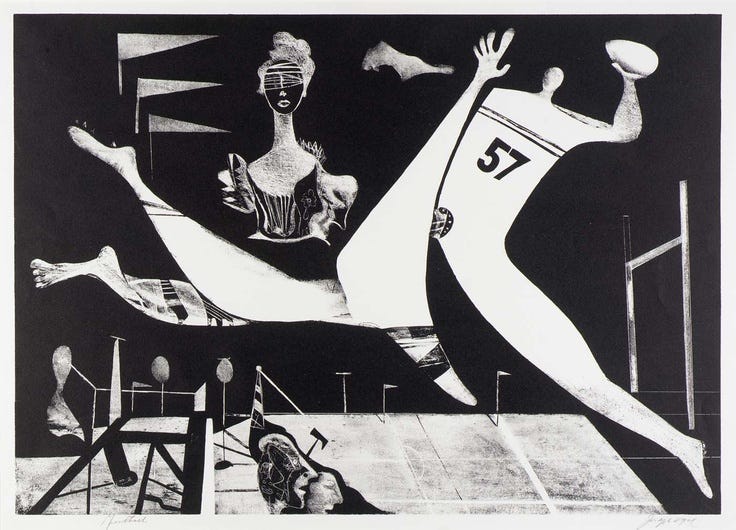
Static. A sportscaster’s voice plays on the radio in my father’s car. The sky gets dark at five pm and the air waves during the drive back home on Thursdays from whatever activity I was dumped at as a child are hijacked by The Game. I watch him slap his leg when they announce a fumble and clench his fist when they advance down the gridiron. But the physics of football make it better for TV—the thrill of watching so many bodies clash together, of seeing someone stretch themselves to sprint across a field, of following a punted ball catch air.
And of course, when medics dart into the ecosystem to pull out an injured player (and the cameramen cannot resist a close-up of a man contorting in agony). They replace him with another body from the bench. A new player enters the hive of the huddle, covered in that exoskeleton gear that makes them look like insects. Break a bone, tear an ACL, destroy your brain—they will find another body.
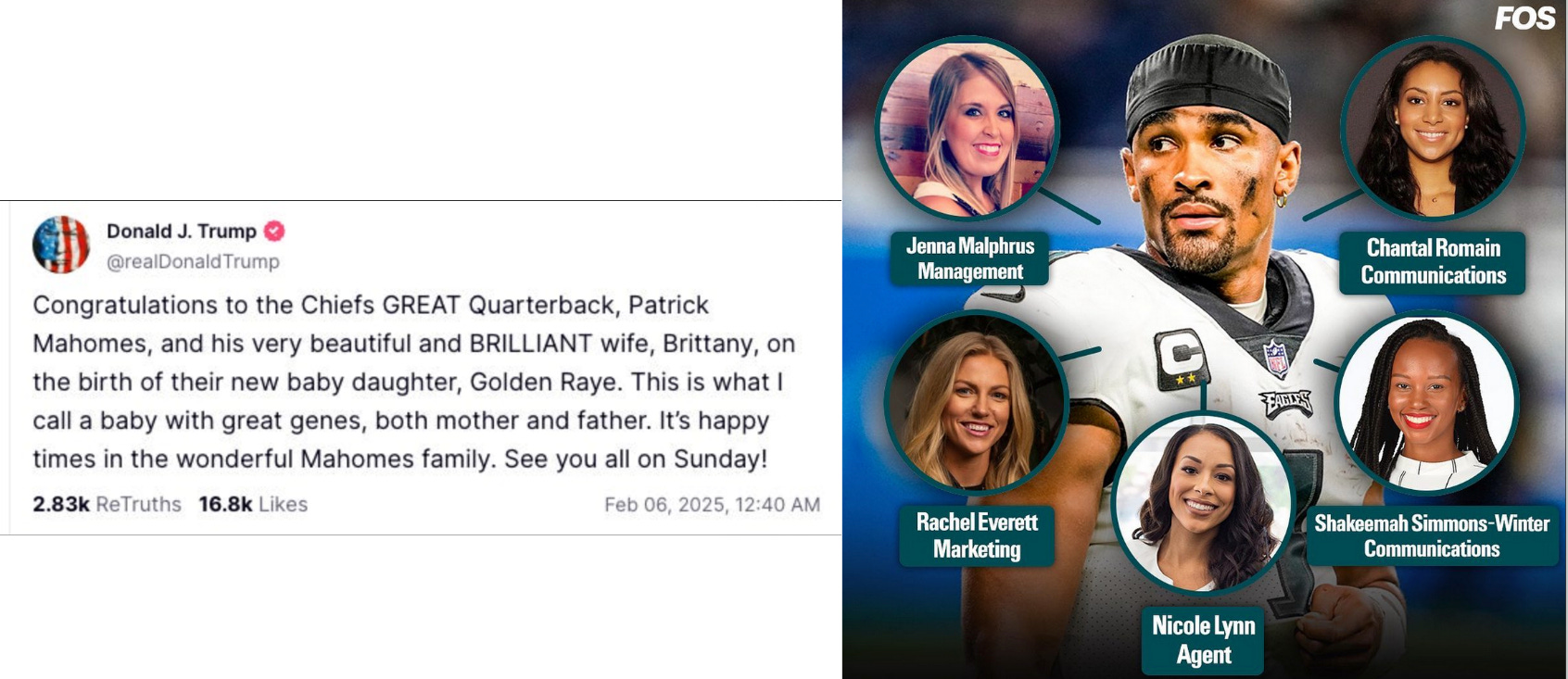
These are war games. A strikingly obvious comparison for any kind of contact sport. But American football in particular lends itself to being a stage for other types of wars. The 2025 Super Bowl seemed to be a stage for the political angst of entering another conservative era—Donald Trump’s vocal support of the Kansas City Chiefs and people making note of Philadelphia Eagles’ quarterback Jalen Hurts having an all-women management team for starters. The Eagles’ win seemed like a symbolic victory for the left, even if the federal government was in the process of being gutted.
Football fans hate it when you make their game political, that’s bad sportsmanship. But it’s always been a sport that found its enormous following through the context of new media technologies and intense commercialization. It is the post-modern American’s favorite pastime.
Basketball is too constrained by the court—courtside celebrity moments get as much attention as dunking the net. It is also a game that has come to be defined by black society, of pick-up games in inner-cities and does not intend to test the resilience of black bodies but prove that they are graceful. It is not a blood sport.
Baseball is too slow, made for an audience that knew about a world without constant distractions, of what it means to wait for the action to start and being rewarded for your patience with the ecstasy of seeing a home run.
Football only becomes “watchable” once television becomes a household staple during the mid-20th century. The mid-to-late 20th century Cold War era is contentious, as are the various political fights for civil rights. But a war game is acceptable—it’s just a game. Here, the men are men and they fight because it’s what men do. And there’s money to be made here, on mining those anxieties that this way of American life still exists and can be preserved.
Advertisers know football is baked into the social fabric of small towns, of Friday Night Lights and college ball. That the eyes glued to TVs in those no-name towns are the source of a bunch of small bills that add up to big bucks. American dreams are alive on the gridiron—for the players, for the audience that feels represented by winning teams, and for the people making money off of all of them.
Advertisers aren’t the only ones who know how to strategize around people’s psychologies. It is famously incredibly difficult to be employed by the National Football League as an organization without leveraging incredible connections.
The exclusive nature of the NFL incentivizes football fanatics who want entry to the club to play in fantasy football leagues where participants can act as team owners/managers or enter into sportsbetting. Sportsbetting is a classic affair but has surged in popularity in recent years due to increased accessibility through platforms like DraftKings and FanDuel.
The club culture of the NFL promotes an almost old-school racketeering atmosphere. The official paychecks being cut for players are so large that it subsequently promotes an unofficial underworld of money that consists of golden handshakes and people desperately tapping buttons on screens.
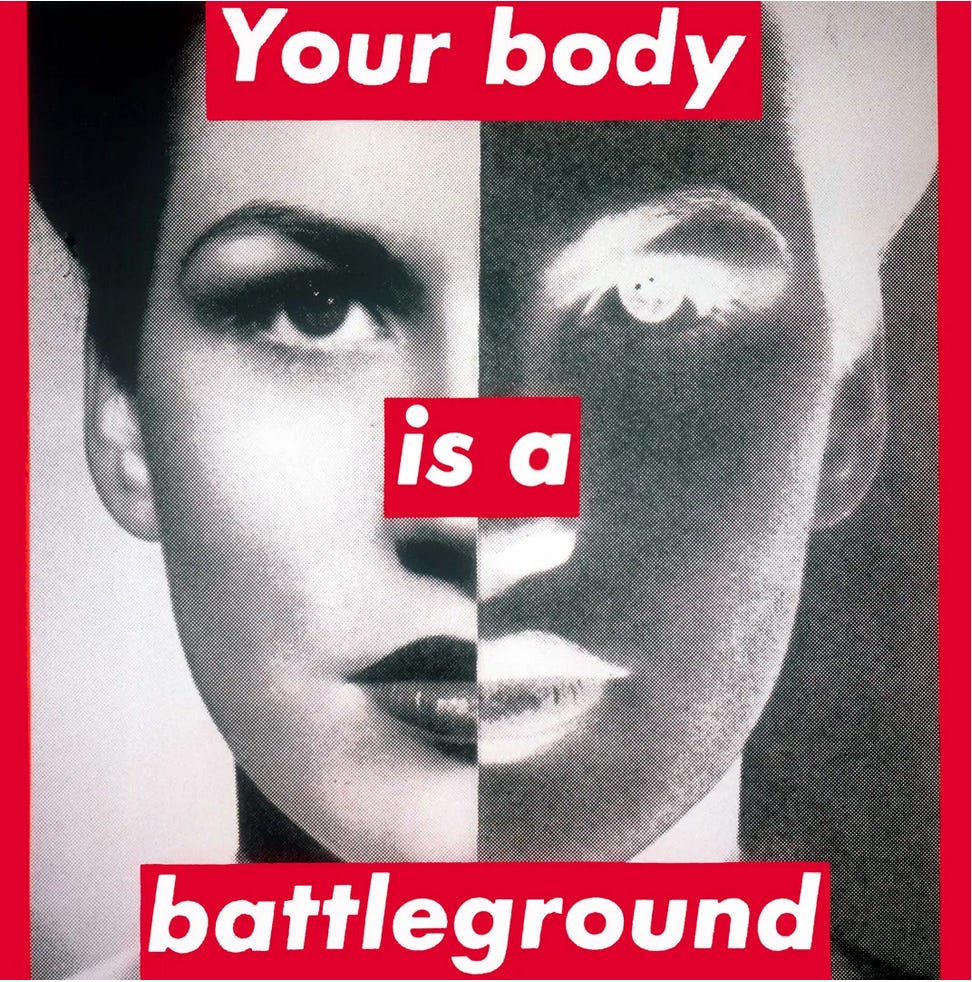
“Your body is a battleground” said Barbara Kruger. Her art was a commentary on the politicization of women’s bodies. But it applies to The Game and its theater of gender. The image of the Quarterback and the Cheerleader as symbols of American hypermasculinity and hyperfemininity makes them ripe for subversion. There’s implicit homoeroticism involved in sex-segregated spaces. Bruce Weber’s Abercrombie and Fitch ads immediately come to mind, as does the queer satire movie But I’m A Cheerleader.
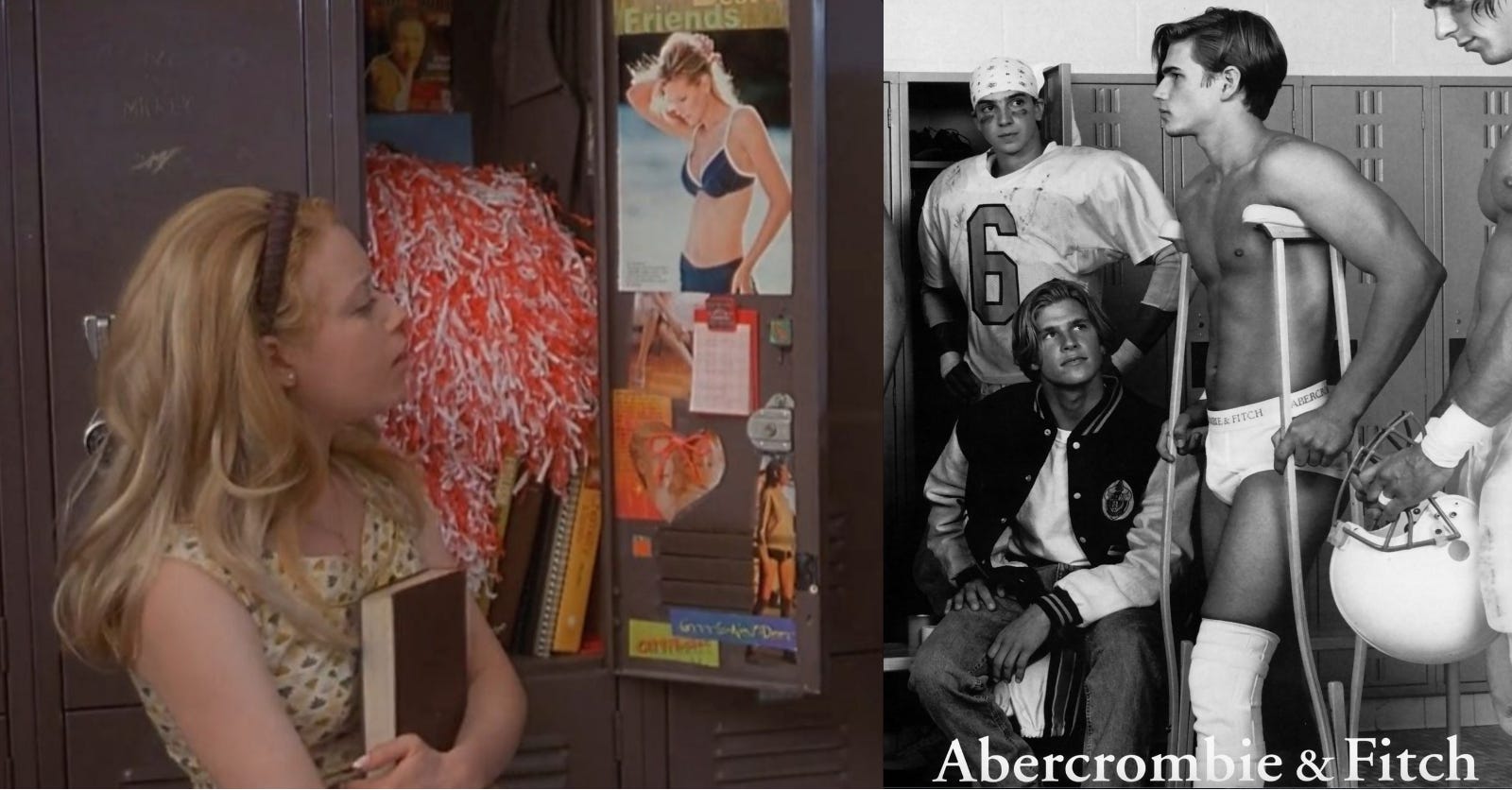
But then the body as a battleground is simply quite literal in the case of The Game. Positions are racialized—the defensive line is overwhelmingly black and the role of the quarterback has historically gone to white men.
The racialization of these positions plays squarely into prizing black bodies for a sort of “raw” athleticism, for having bodies that are perceived as stronger and more resilient to trauma. But the defensive line being predominantly black men also means they are at a higher risk for chronic traumatic encephalopathy or CTE.
And yet, racism still prevents black players suffering from CTE from getting effective treatment and compensation due to the NFL’s binary race-based scoring system for brain testing. This test assumed black players start with lower cognitive function and, therefore, were not as affected by CTE. The system—one test for black people and another for everyone else—was in effect until 2021. The severe physical repercussions of the politicization of players’ bodies make The Game a war in every sense of the word.
In truth, I love The Game. I love watching people fight. The Game is life-affirming without being self-conscious the way a tedious movie or book might be. We fight, we argue, we confront one another, because this is human. We play, because this is human. And I love The Game because I get to scream. It is great to scream but even better to do it with others. I am completely in my body when I scream. I was a young girl when my hometown’s team won the Super Bowl. Classes were almost entirely empty with the exception of a few students who didn’t attend the parade. I was one of them. We spent our day mostly playing games. I was a quiet kid who had lost quite a bit of self-confidence when I had switched schools. My teacher told me that he’d award me extra credit if I screamed “Seahawks” as loud as I possibly could. The other kids giggled at his proposition. I held my breath and then screamed like a banshee. I remember his startled face. I got my extra credit.
More Materials and Moodboard:
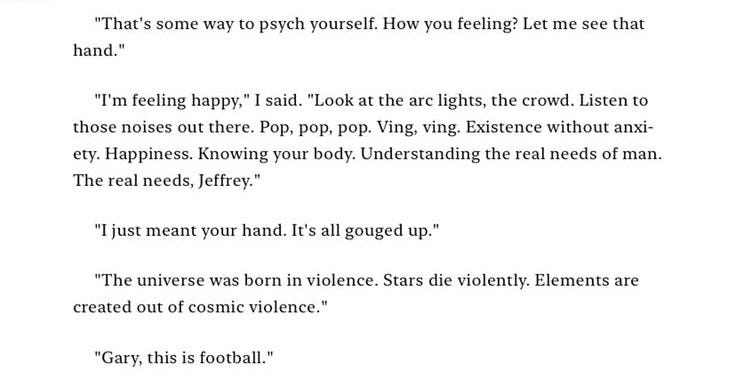
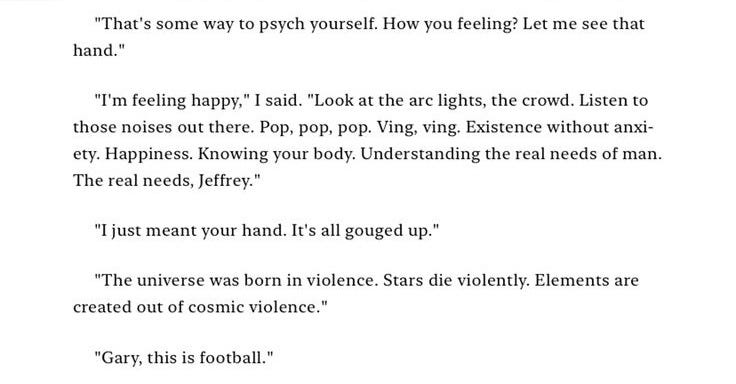
Don DeLillo’s football novel End Zone. Nuclear war anxieties, 1970s race relations, and a drifter student-athlete protagonist named Gary. They should really adapt this into a movie, it’s so so so good. Perfect excerpt from the book:
My favorite football movies are probably Any Given Sunday and Friday Night Lights. The former because it really captures the economics of the game—how managers, coaches, and players interact. The later because of sentiment. Honorary mention is Remember The Titans, my dad’s favorite which I watched with him several times as a kid.
Moodboard: the art, ads, movies, fashion, and history that I looked to when trying to write about football. Check it out here on Pinterest, preview available below: